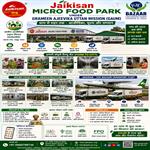
Grameen Ajeevika Utthan Mission (GAUM)
CONCEPT NOTE
Scaling Inclusive Rural Livelihoods through Cooperative, Women-Led and Market-Linked Enterprises in India
Grameen Ajeevika Utthan Mission (GAUM)
Proponent
Jaikisan.org
Jaikisan Institute of Rural Management & TechnologyDigital Financial Inclusion with Mittreli ( Fintech )
Marketing Linkage with V2c Bazaar Pvt Ltd
Lead Practitioner: Acharya Sanjiv Sharma as Founder
Managed by Executive members and State SHG of promotor and Investors
1. Background and Development Context
Despite sustained economic growth, rural India continues to face structural challenges that limit inclusive and durable poverty reduction. Smallholder farmers remain vulnerable to price volatility, low value capture, fragmented markets, and climate risks. Women’s participation in the rural economy is largely informal and under-remunerated. While public investments have expanded infrastructure, social protection, and financial access, the transition from welfare-based support to enterprise-led income generation remains incomplete.
Key structural constraints include:
- Limited value addition at the village level
- Weak aggregation and market access for small producers
- Underdeveloped rural enterprises and MSMEs
- Restricted productive use of finance by women and farmers
- High dependence on subsidies without sustainable revenue models
There is a growing policy consensus that rural transformation requires integrated systems that combine livelihoods, enterprise development, finance, markets, and institutions in a financially sustainable manner.
2. Rationale for the Intervention
The proposed Grameen Ajeevika Utthan Mission (GAUM) responds to this need by offering a scalable framework that positions villages as productive economic units. The mission is grounded in the principle that long-term poverty reduction and shared prosperity are achieved when communities are owners of enterprises rather than beneficiaries of schemes.
GAUM builds on more than two decades of field implementation experience across diverse geographies, agro-climatic zones, and social contexts. It integrates cooperative governance, women-led enterprises, digital finance, and market linkages into a unified rural economic system.
The intervention is particularly relevant to World Bank and IFAD priorities on rural livelihoods, smallholder agriculture, women’s economic empowerment, food systems, and climate resilience.
3. Programme Objectives
The overall development objective is to increase sustainable rural incomes and employment through cooperative, women-led, and market-linked enterprises.
Specific objectives are to:
- Enable smallholder farmers to move up the value chain through local processing and aggregation
- Create large-scale, sustainable employment opportunities for rural women and youth
- Strengthen farmer collectives and women SHGs as enterprise owners
- Expand financial inclusion from access to productive use of finance
- Improve food system efficiency, safety, and traceability
- Promote climate-resilient and low-emission rural enterprises
4. Target Beneficiaries
Primary beneficiaries include:
- Smallholder and marginal farmers
- Women Self-Help Group members
- Tribal and forest-dependent communities
- Rural youth engaged in skilling and enterprise management
The programme will prioritise aspirational districts, backward regions, and climate-vulnerable geographies, with a strong focus on inclusion of women and socially disadvantaged groups.
5. Programme Components
Component 1: Cooperative-Based Rural Enterprises
This component will establish cooperative corporate structures owned by farmers and women SHGs. These entities will operate rural enterprises including food processing, value addition, packaging, storage, and logistics.
Key activities:
- Formation and strengthening of cooperatives and producer institutions
- Governance, accounting, and compliance systems
- Equity participation by community members
Component 2: Rural Micro Food Parks
Decentralised Micro Food Parks will be established at village or cluster level to enable local value addition.
Key activities:
- Infrastructure development (processing, cold storage, packaging)
- Quality control and food safety systems
- Branding and certification support
Component 3: Women-Led Livelihoods and SHG Enterprises
Women SHGs will be positioned as shareholders and operators of enterprises.
Key activities:
- Enterprise development and management training
- Access to working capital and equipment
- Market linkages for SHG-produced goods
Component 4: Financial Inclusion and Digital Systems
The programme will deploy digital transaction and record-keeping systems to ensure transparency, traceability, and access to finance.
Key activities:
- Digital payment and accounting platforms
- Credit linkage and joint liability mechanisms
- Insurance and risk mitigation products
Component 5: Skills, Capacity Building and Knowledge Systems
Continuous skilling and institutional capacity building will underpin programme sustainability.
Key activities:
- Training of trainers and community resource persons
- Digital learning platforms
- Exposure visits and peer learning
Component 6: Market Access and Value Chain Integration
The programme will connect rural enterprises directly to domestic and international markets.
Key activities:
- Aggregation and logistics systems
- E-commerce and institutional buyer linkages
- Price discovery and demand forecasting
6. Implementation Arrangements
Implementation will be led by Jaikisan.org through a dedicated Programme Management Unit. Execution will be undertaken in partnership with state governments, rural livelihood missions, cooperatives, financial institutions, and private sector partners.
A phased rollout approach will be adopted, beginning with pilot districts and scaling based on performance and readiness.
7. Financing Plan and Sustainability
The programme will use a blended finance approach combining:
- Multilateral concessional finance
- Government convergence funds
- Impact and catalytic capital
- Community equity contributions
Revenue from enterprises will progressively reduce dependence on external support, ensuring long-term sustainability.
8. Expected Results and Impact
Indicative outcomes include:
- Establishment of 8,000 Rural Micro Food Parks
- Creation of approximately 1.75 million direct rural jobs
- Self-employment opportunities for 1.75 crore women
- Integration of 6.5 crore farmers into organised value chains
- Increased and diversified household incomes
9. Gender and Social Inclusion
Gender equality is a core design principle. Women will be prioritised as enterprise owners, managers, and decision-makers. Targeted strategies will ensure inclusion of tribal communities and vulnerable groups.
10. Climate and Environmental Considerations
The programme promotes climate-resilient agriculture, decentralised processing to reduce emissions, and adoption of clean energy solutions where feasible.
11. Monitoring, Evaluation and Learning
A results framework aligned with development partner requirements will track outputs, outcomes, and impacts. Digital systems will support real-time monitoring and adaptive management.
12. Risks and Mitigation Measures
Key risks include institutional capacity constraints, market volatility, and climate shocks. Mitigation strategies include phased implementation, diversified value chains, insurance mechanisms, and strong governance systems.
13. Conclusion
The Grameen Ajeevika Utthan Mission presents a scalable and replicable pathway for inclusive rural transformation. Support from the World Bank / IFAD / NABARD / Ministry of Cooperative would enable accelerated implementation, institutional strengthening, and global learning from a proven, community-owned development model.